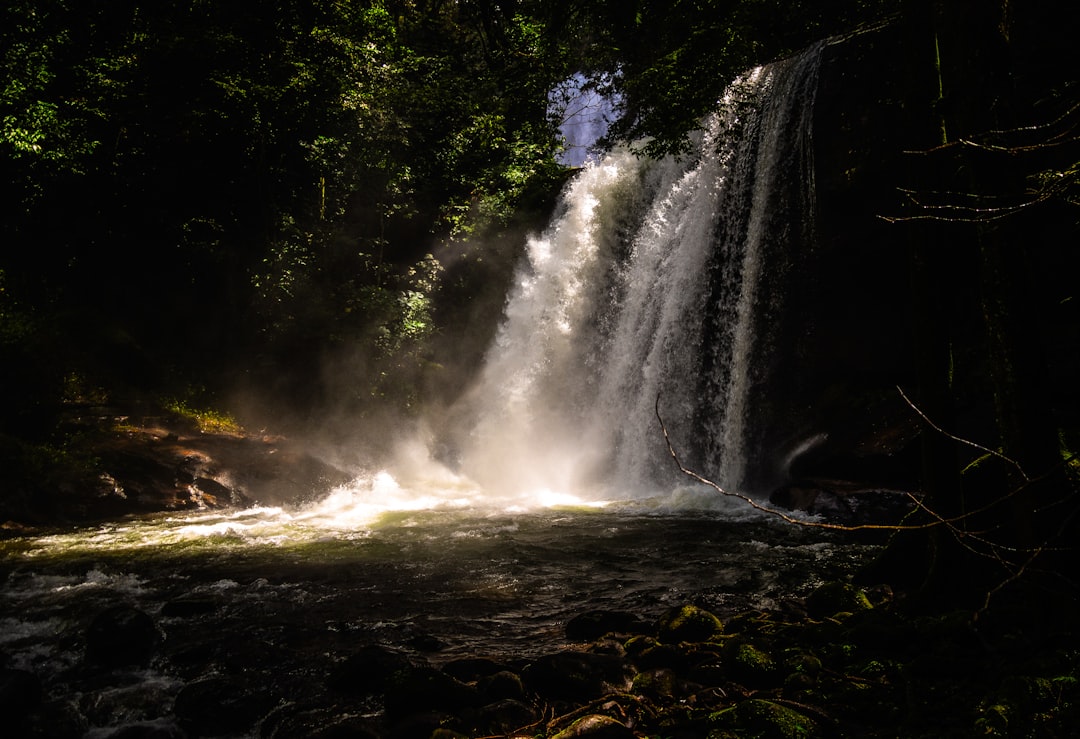
Lopé National Park
Lopé is Gabon's flagship national park and the only place in the world where ancient open savannah and equatorial rainforest exist side by side — a landscape that has persisted unchanged since the Pleistocene. The park covers 497,000 hectares in the centre of the country, bisected by the Ogooué River and its tributaries.
The savannah zones — maintained by fire and elephant grazing — date back at least 15,000 years, providing a rare window into an Ice Age Africa that was largely grassland. This ancient quality earned the park UNESCO World Heritage designation in 2007, as part of the Greater Lopé-Waka Ecosystem.
Wildlife in Lopé is spectacular. The park is home to an estimated 2,000 western lowland gorillas, over 400 chimpanzees, and the largest concentration of forest elephants in Central Africa — herds of up to 100 individuals have been recorded crossing the savannah at dusk. Mandrills, the world's largest monkey species, move through the forest in troops numbering in the hundreds.
Birdlife is extraordinary: 430 species have been recorded, including the African grey parrot, the great blue turaco and the elusive forest robin. The Ogooué River shelters hippos, freshwater crocodiles and the Nile monitor lizard.
The Lopé Hotel, the park's main lodge, offers guided forest walks, night drives and river excursions led by experienced trackers. Research facilities at the Station d'Études des Gorilles et Chimpanzés (SEGC) have been operating continuously since 1984, making Lopé one of the longest-running primate research sites in Africa.
Best time to visit: June–September (dry season). Access by train from Libreville (the Transgabonais railway stops at Lopé village, 6 hours) or by charter flight to the park airstrip.
Moukalaba-Doudou
Far in the southwest of Gabon, where the Doudou Mountains rise above the coastal plain, Moukalaba-Doudou National Park covers 449,000 hectares of primary forest that sees fewer than 300 tourists per year. This inaccessibility is, paradoxically, its greatest asset.
The park harbours the densest known concentration of habituated western lowland gorillas in Gabon. At the Doussala research camp, scientists from the Gorilla Protection Project have spent years slowly familiarising several gorilla groups to human presence — a process requiring daily, years-long contact. Today, groups of between 8 and 14 individuals can be approached to within metres, without distress to the animals.
A gorilla trek in Moukalaba-Doudou is not a sanitised tourist package. You walk — sometimes for three to four hours — through dense understorey, navigating by the fresh knuckle prints and dung piles left by the group. Your guide, typically a member of the local Bapunu community, reads the forest with a precision that takes a lifetime to acquire. When you finally find the group — a silverback sitting impassively in a beam of filtered light, juveniles tumbling around him — the experience is visceral and unforgettable.
Leopards are present but rarely seen. Chimpanzees overlap with the gorillas in some zones of the park. The Doudou River, which cuts through the park, attracts hippos and forest buffalo. Over 400 bird species have been recorded, including the grey-cheeked hornbill and the African broadbill.
Getting there: Charter flight from Libreville to Tchibanga (2 hours), then 4WD track to Doussala. Advance booking at the Gorilla Protection Project is essential. Permits are strictly limited to protect the habituated groups.
Pongara National Park
The most accessible of Gabon's national parks, Pongara sits directly across the Gabon Estuary from Libreville — 40 minutes by boat. Despite its proximity to the capital, it remains genuinely wild. The park's 92,000 hectares encompass Atlantic beach, mangrove forest, coastal lagoons and interior rainforest — a compact cross-section of Gabon's coastal ecosystems.
Pongara's beaches are among the most important nesting sites for leatherback sea turtles in Africa. Between October and March, female leatherbacks — some weighing over 900 kg and measuring two metres in length — haul themselves ashore at night to excavate nests in the dark sand. Conservation teams from the African Parks network monitor nests and hatchings, and visitors can join guided night walks to witness this primordial spectacle.
Forest elephants are regularly seen on the beach in the early morning, having walked from the interior forest to drink from freshwater seeps near the tideline. Buffalo, red river hogs and various duiker species are common in the forest interior. The mangrove channels are navigated by guided kayak, offering intimate access to a tidal ecosystem alive with fish eagles, kingfishers and herons.
Accommodation ranges from simple bush camps to the comfortable Pongara Lodge, which runs daily boat transfers from Libreville. The park offers the unusual experience of combining equatorial wildlife with Atlantic beaches in a single day's itinerary.
Sea turtle season: October to March. Book night-walk permits well in advance during peak season (December–January). Day trips from Libreville are feasible; overnight stays are recommended for the full experience.
Other Remarkable Parks
The "Africa's Last Eden" park, where surfing hippos and forest elephants on the beach are a real possibility. 155,000 ha of pristine Atlantic coast, lagoons and rainforest. Humpback whales pass offshore between July and September.
Home to the spectacular Kongou Falls — one of the widest waterfalls in Africa. Deep primary forest shelters one of the densest chimpanzee populations in Central Africa, and the Langoué Bai forest clearing draws forest elephants, gorillas and bongo antelope.
Gabon's most remote and least visited park: 756,000 hectares of unbroken primary forest abutting Cameroon and Equatorial Guinea. No tourist infrastructure exists — this is wilderness in the purest sense, accessible only to well-supported expeditions.
A narrow coastal strip in the far south, Mayumba hosts the largest leatherback turtle nesting beach in the world — over 10,000 nests per year. Humpback whales give birth in the warm waters offshore. An extraordinary convergence of marine megafauna.